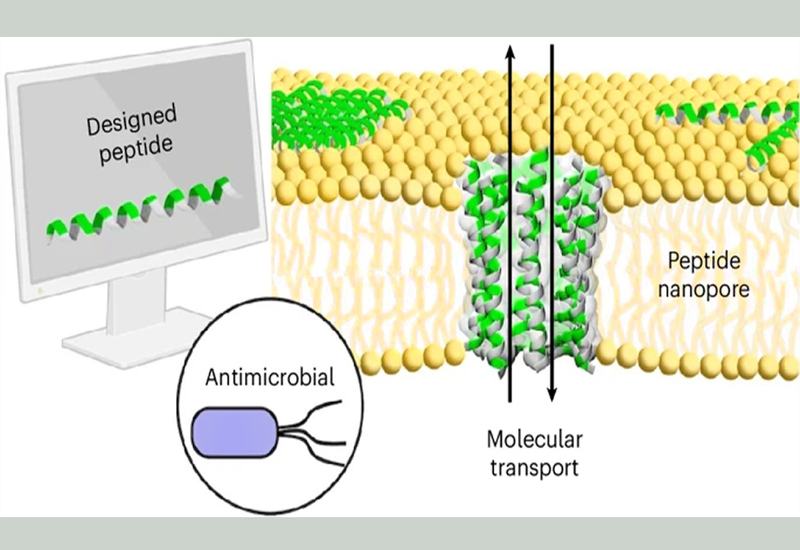
Antimicrobial peptides that physically rupture bacterial membranes are attractive candidates for next-generation antibiotics because membrane disruption is difficult for bacteria to counter with single-gene mutations. Among the structural archetypes available, barrel-stave pores, TBPs, are particularly appealing: amphipathic α-helices self-assemble into transmembrane bundles that open a water-filled channel, rapidly collapsing membrane potential and ion gradients. Yet despite decades of research on natural pore-formers such as alamethicin, generalizable rules for designing synthetic TBP-forming peptides from first principles have remained elusive. Single-residue substitutions can either stabilize or destroy pore assembly, and no prior de novo-designed peptide had demonstrated both confirmed barrel-stave architecture and antimicrobial activity.
Researchers in the Vácha Group at Masaryk University and the de la Fuente-Nunez Group at the University of Pennsylvania, published in Nature Chemical Biology, addressed this gap with a modular computational pipeline. Using the coarse-grained Martini 2.2 force field in GROMACS, the team ran 51-μs unbiased molecular dynamics simulations of approximately 150 systematically varied amphipathic 30-residue peptides preassembled into octameric TBPs within POPC lipid bilayers. Pore stability, scored by the number of transmembrane helices remaining at simulation end, served as the primary design metric. Key predictions were validated by 2-μs all-atom simulations, then experimentally confirmed via calcein leakage assays with large unilamellar vesicles, planar lipid bilayer electrophysiology, real-time atomic force microscopy on supported lipid bilayers, circular dichroism spectroscopy, and dextran transport across giant unilamellar vesicles.
The simulations revealed three cooperative stabilizing elements. First, precise placement of aromatic tryptophan and phenylalanine residues on the hydrophobic face drives intermolecular π–π stacking; optimal positions shifted from residues 13 and 19 in 30-residue hydrophobic stretches to 13, 15, 8, and 26 when the core was shortened to 22 residues and the helices tilted from 50° to 30° relative to the membrane normal. Second, arginine–aspartic acid salt bridges on the hydrophilic face, arranged in "charge zipper" ladders across each peptide–peptide interface, increase pore stability with higher density: designs in groups C and D, carrying four salt bridges per interface, maintained pore integrity even when aromatic stacking was removed. Third, cationic terminal residues stabilize the antiparallel transmembrane orientation and tune membrane affinity; cationic peptides showed roughly 20 kJ mol⁻¹ greater affinity for anionic POPE:POPG bilayers mimicking bacterial membranes than for zwitterionic POPC. From this analysis the authors distilled 52 permissible sequence templates grouped into four classes by interaction density.
Twenty-two synthesized peptides broadly validated the simulation predictions, with calcein leakage from POPC:POPG vesicles correlated with computed pore hydration. The lead peptide, KDFA2i + 9-NH₂, induced roughly 20% calcein release at a peptide-to-lipid ratio of 1:2,000 and approximately 75% at 1:500. Planar lipid bilayer recordings showed discrete, stepwise conductance increases (0.116, 0.251, 0.353, and 0.424 nS at +100 mV in 100 mM NaCl) consistent with additive single-pore events, and AFM imaging visualized stable nanopores approximately 6 nm wide within 20 min of peptide addition. Against a panel of ESKAPEE pathogens, KDFA2i + 9-NH₂ achieved a minimum inhibitory concentration of 0.5 μM against A. baumannii ATCC 19606 and 1 μM against drug-resistant Escherichia coli AIC221, while remaining non-hemolytic up to IC50 values exceeding 2,500 μM. The peptide selectively depolarized bacterial cytoplasmic membranes without permeabilizing the Gram-negative outer membrane, consistent with inner-membrane nanopore formation as the dominant mechanism. In two preclinical mouse models of A. baumannii infection, topical and intraperitoneal administration of KDFA2i + 9-NH₂ reduced bacterial burden by approximately 2 logs, and resistance evolution experiments showed only a transient, reversible MIC shift under selective pressure.
The framework presented here converts sequence-level design rules into experimentally validated, tunable antimicrobial nanopores, a capability that had not previously existed for the barrel-stave pore class. The 52 modular sequence templates provide a practical starting library for researchers targeting pathogens beyond the ESKAPEE panel or requiring selective ion-transport properties. Because pore size scales with oligomeric state and can be adjusted by sequence, the same design logic extends to synthetic biosensors and drug-delivery channels. The authors also note that AlphaFold 2 and AlphaFold 3 failed to predict barrel-stave assembly in the absence of an explicit lipid environment, underscoring the continued importance of membrane-explicit molecular dynamics for transmembrane peptide design. Further optimization of membrane affinity, serum stability, and oligomeric selectivity will be needed before clinical translation, but the preclinical profile of KDFA2i + 9-NH₂ against a World Health Organization priority pathogen supports continued development.